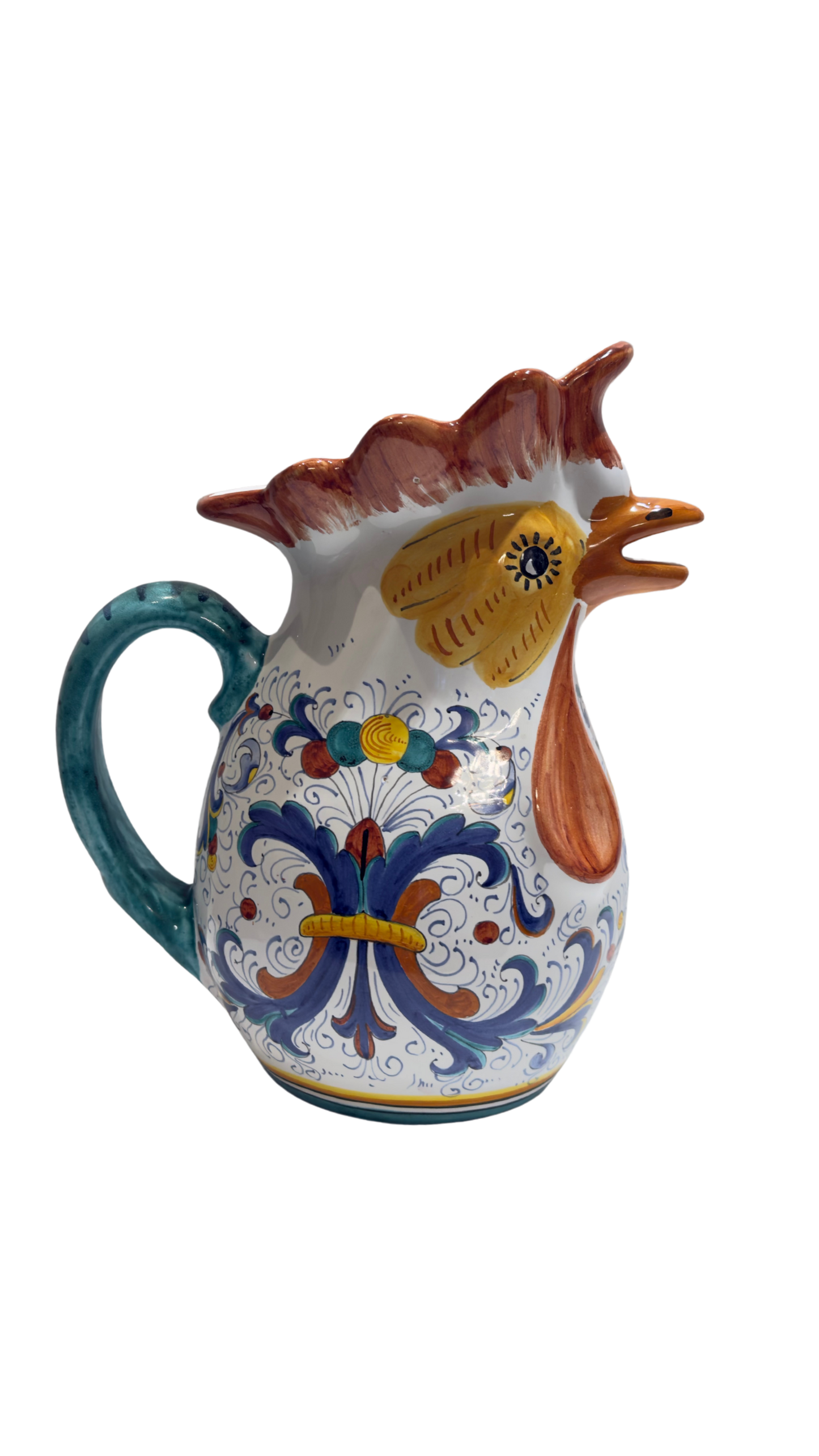


VINTAGE & COLLECTIBLE CERAMICS 2 Qt. Ricco Deruta Rooster Pitcher — CAMA Ceramiche, Deruta
VINTAGE & COLLECTIBLE CERAMICS 2 Qt. Ricco Deruta Rooster Pitcher — CAMA Ceramiche, Deruta
SKU: 6468
Couldn't load pickup availability
DESCRIPTION
DESCRIPTION
From a private Italian collection
Curated artisan ceramic centerpiece
Handcrafted by Cama in Italy
Rare Italian Maiolica | Collector’s Piece
This 2 Qt. Rooster Pitcher by CAMA Ceramiche is an authentic surviving example of one of Deruta’s most enduring and symbolically rich ceramic forms. Handcrafted and hand-painted in Italy prior to the workshop’s closure in 2011, this pitcher represents both a finished chapter in Italian ceramic history and a continuation of a motif that dates back centuries.
The Rooster and Its Medici Legacy
The rooster (gallo) has long held powerful symbolism in Italian culture—representing vigilance, prosperity, and civic pride. During the Renaissance, the rooster became closely associated with Florence and the ruling House of Medici, who embraced the image as a symbol of strength, protection, and enlightened leadership. Roosters appeared in Medici-influenced decorative arts, architecture, and household objects, reinforcing their role as guardians of the city and its people.
In Deruta, this symbolism was absorbed into the language of maiolica. Artisan workshops interpreted the rooster not merely as decoration, but as a cultural emblem—one meant to appear on functional objects used daily at the table. The rooster pitcher thus became both practical and ceremonial: a vessel for wine or water, and a statement of heritage, hospitality, and continuity.
A Finite Chapter of Craftsmanship
Decorated entirely by hand in the classical Deruta palette—cobalt blue, green, ochre, and warm yellow—this CAMA rooster pitcher reflects Renaissance-inspired scrollwork and rhythmic banding characteristic of the workshop’s finest production. The generous 2-quart capacity and sculptural handle balance form and function, while subtle variations in brushwork attest to the human hand behind the piece.
Because original CAMA pieces are no longer produced, surviving examples such as this rooster pitcher are now regarded as historical objects—tangible links to a moment when craftsmanship, community, and cultural continuity guided production. Each remaining piece carries not only artistic value, but historical resonance, connecting the collector to centuries of Italian ceramic tradition.
Highly sought after by collectors of Italian ceramics, the CAMA rooster pitcher stands at the intersection of Renaissance symbolism, cooperative artisan production, and enduring functional art.
A rare opportunity to acquire a living symbol of Italian history and ceramic heritage.
Why This Rooster Pitcher Is Collectible
-
Produced by CAMA Ceramiche (1954–2011), now closed
-
Rooster motif rooted in Renaissance and Medici symbolism
-
Hand-painted Italian tin-glazed maiolica
-
Finite and diminishing number of original examples
-
Strong collector demand for documented Deruta forms
- Pristine
Own a piece of Deruta’s legacy—bring home CAMA original today.
The small imperfections such as the difference in color, shape, diameter or small bubbles that form inside, do not constitute a defect but testify that it is actually an artisanal product.
ARTISAN STORY
ARTISAN STORY
The Heritage of CAMA Ceramiche
Deruta, Umbria — Founded 1954 · Closed 2011
In the storied hill town of Deruta, where ceramic tradition has flourished since the Middle Ages, CAMA Ceramiche stood for more than half a century as a guardian of authentic Italian maiolica.
Founded in 1954, CAMA—an acronym for Cooperativa Artigiana Maioliche Artistiche—was established as an artisan cooperative at a time when Italy was rebuilding its cultural and economic identity after the war. Rather than pursuing industrial production, CAMA was built on a collective philosophy: to preserve handcraft, protect artisan livelihoods, and uphold the visual language of classic Deruta ceramics.
From its earliest years, CAMA became known for its commitment to traditional tin-glazed majolica, using time-honored techniques that date back to the Renaissance. Each piece began as carefully prepared clay, shaped by hand or traditional molds, then fired, glazed in luminous white, and meticulously painted freehand with mineral pigments. No stencils. No shortcuts. Only the steady hand of a trained painter and the discipline of centuries-old methods.
A Workshop Defined by Artists, Not Machines
For decades, CAMA was closely associated with the Niccacci family, whose leadership and artistic vision helped define the workshop’s identity. Under their stewardship, CAMA produced tableware and decorative pieces that were both functional and expressive—ceramics meant to live on the table, not behind glass, yet beautiful enough to be collected and cherished.
CAMA’s designs drew deeply from Deruta’s classical vocabulary: scrolling foliage, balanced florals, mythic creatures, and rhythmic patterning rendered in rich blues, greens, ochres, and yellows. The now-recognizable yellow rim, seen across many CAMA forms, became a quiet signature—warm, optimistic, and unmistakably Italian.
While rooted in tradition, CAMA was never static. Its painters brought individuality to every piece, resulting in subtle variations that collectors quickly learned to recognize and value. These differences were not flaws, but proof of authenticity—evidence that each bowl, plate, or cup had passed through human hands.
International Recognition and Cultural Presence
By the late 20th century, CAMA Ceramiche had earned a devoted international following, particularly in the United States. Their work appeared in influential cookbooks, lifestyle publications, and even popular film—cementing CAMA’s reputation as a symbol of Italian conviviality and everyday elegance.
American collectors formed lasting relationships with the workshop, some visiting Deruta repeatedly to meet the artisans and commission pieces. These relationships outlived the company itself, giving rise to informal preservation efforts and collector communities dedicated to documenting CAMA’s legacy.
The End of a Workshop, Not a Tradition
Despite its artistic success, CAMA Ceramiche closed in 2011, after 57 years of production. Like many historic artisan workshops, it faced mounting economic pressures, shifting global markets, and the growing dominance of mass production. Attempts to restructure or continue the cooperative model ultimately proved unsustainable.
Yet CAMA’s closure marked the end of a workshop—not the end of its significance.
Today, original CAMA pieces are no longer produced, making surviving examples increasingly sought after by collectors of Italian ceramics. Each bowl or cup that remains is now a historical object: a tangible link to a moment when craftsmanship, community, and cultural continuity guided production.
Why CAMA Matters Today
In an era defined by speed and replication, CAMA Ceramiche represents something rare:
a complete, intact artisan philosophy—from material to motif, from workshop to table.
Owning a CAMA piece is not simply owning Italian ceramics. It is preserving a chapter of Deruta’s living history, a cooperative model of craftsmanship, and a standard of beauty shaped by patience, skill, and shared values.
CAMA Ceramiche (1954–2011).
Made by hand. Meant to be used. Remembered with reverence.
CARE INSTRUCTIONS
CARE INSTRUCTIONS
Italian ceramics are heirloom quality products, and can last lifetime with proper care. We have some suggestions that will preserve your majolica for years to come.
Majolica is dishwasher safe, but many people choose to hand wash their pieces as a precaution. Because majolica is a porous material, some pieces are not meant to hold liquid for a long period of time. Check for warning labels before ordering a product, as the pieces that are most notorious for "sweating" are appropriately labeled.
Majolica is sensitive to extreme temperatures, specifically boiling or freezing liquids. Pouring water with a rolling boil directly into a teapot, for example, may lead to breakage. To avoid this, temper the object. The industry standard is 620 degrees Celsius (1,148 degrees Fahrenheit). Quench the glass to cool it.
Crazing is common in well used majolica. The tiny cracks in the glaze do not affect the functionality of your majolica.
Majolica hand-crafted products should not be microwaved, as it may crack and/or break the ceramics.
SHIPPING INFORMATION
SHIPPING INFORMATION
UPS Ground
Flat shipping charge of $10 for each shipment of merchandise under $100.00. For orders of $100.00 or more, shipping is 10% of the order total.
UPS Next Day Air
Flat shipping charge of $63 for each shipment of merchandise under $70.00. For orders of $70.00 or more, shipping is 90% of the order total.
UPS 2-Day Priority (Rush Shipping)
Flat shipping charge of $42 for each shipment of merchandise under $70.00. For orders of $70.00 or more, shipping is 60% of the order total. Note: This option is required for shipping to Alaska and Hawaii.
USPS 3-Day Priority
Flat shipping charge of $21 for each shipment of merchandise under $70.00. For orders of $70.00 or more, shipping is 30% of the order total.
International Shipments
Please contact us at customerservice@biordi.com or call us at (415) 392-8096 for quotes to ship internationally.
You will be charged a rate based on your delivery area, value and shipping preference. For items shipped via UPS, see below for information pricing information. Once the package is shipped, you will receive an email with tracking information to track your package.